

“From Norodom Palace to Independence Palace”
Exhibition “From Norodom Palace to Independence Palace” – A New Approach to History
According to Ms. Tran Thi Ngoc Diep, Director of the Reunification Hall (Ho Chi Minh City), the exhibition presents a completely new approach to historical interpretation. Instead of displaying historical documents in a traditional manner, the exhibition places them within a broader context, allowing visitors to better understand history as a continuous process rather than isolated events.
The exhibition emphasizes that the history of the Independence Palace cannot be separated from the historical transformations of Saigon and Vietnam. Therefore, its core content focuses on the journey from Norodom Palace to Independence Palace, highlighting the political, social, and cultural changes associated with the site.
Professor Edward Miller’s Interactive Historical Experience
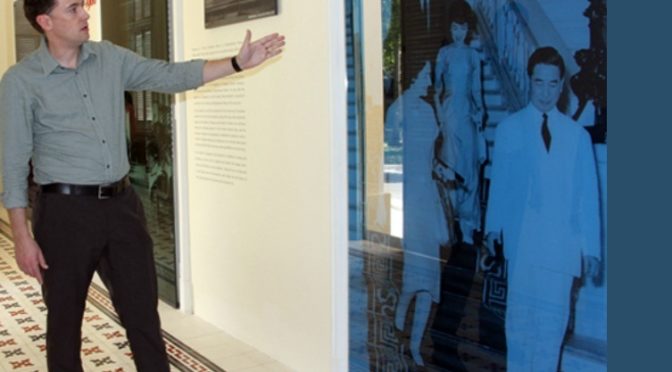
Professor Edward Miller highly appreciates the exhibition’s interactive approach, which encourages visitors to actively engage with historical materials. Rather than merely viewing artifacts, visitors are invited to explore, reflect, and draw their own conclusions about historical events.
A key highlight of the exhibition is the application of modern multimedia technology combined with vivid visual design. This approach transforms historical documents into immersive experiences, enabling visitors not only to “see” but also to “feel” and “interact” with history.
A Result of Long-Term Research and Collaboration
The exhibition is the result of more than three years of research and preparation by the Reunification Hall, with consultation from historians and museum experts such as Dr. Nguyen Van Huy, Dr. Le Thi Minh Ly (National Heritage Council), and Professor Edward Miller.
A Historic Villa within the Independence Palace Complex
The exhibition space is located in a two-story historic villa within the Independence Palace complex, along Nguyen Du Street (District 1). This building itself is a valuable historical artifact, contributing to the authenticity of the exhibition experience.
On the ground floor, rare images and documents about Norodom Palace—the residence and workplace of the Governor of Cochinchina built by the French colonial administration in 1868—are presented, many of which are being displayed publicly for the first time.
Some photographs are enlarged and combined with recreated settings, allowing visitors to feel as if they are stepping into historical spaces from more than a century ago.
Multimedia Storytelling of Saigon’s Past
Inside the exhibition, multiple large screens present short documentary films created from archival images and documents. These films illustrate the process from the laying of the first stone of Norodom Palace to major historical events such as the 1962 bombing that destroyed the left wing of the building.
The everyday life of Saigon in earlier periods is also vividly recreated. Visitors can watch images, listen to narration, and experience the sounds of Saigon’s streets, gaining a deeper sensory understanding of the city’s past.
Historical Phases and Political Transformations
From 1887 to 1945, Norodom Palace served as the residence and workplace of successive French Governors-General of Indochina.
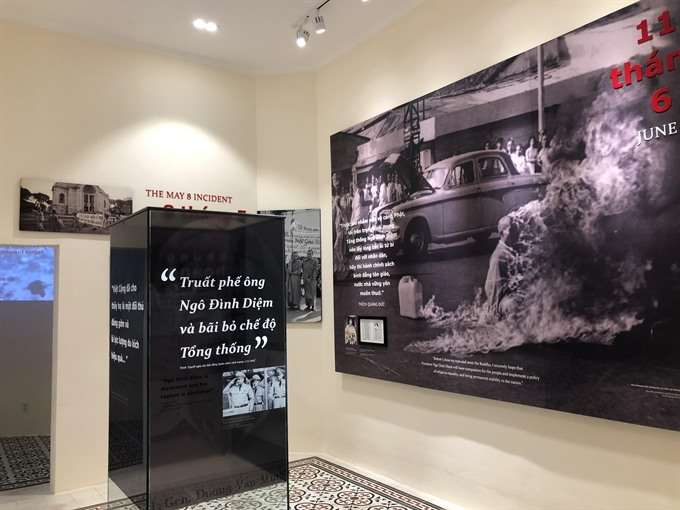
After 1954, the exhibition highlights the period under the administration of Ngo Dinh Diem, the renaming of Norodom Palace to Independence Palace, and the political upheavals that followed. These events are presented through photographs, documents, artifacts, and detailed explanations.
Interactive displays and educational games are incorporated to help visitors, especially younger audiences, engage more easily with complex historical narratives.
From Destruction to Reconstruction
The exhibition also documents the February 27, 1962 bombing of Independence Palace, which caused severe damage and led to the decision to demolish the old structure and construct a new palace based on the design by architect Ngo Viet Thu.
After the assassination of Ngo Dinh Diem in 1963, construction continued, and the palace was officially inaugurated on October 31, 1966, with President Nguyen Van Thieu presiding over the ceremony. He lived and worked at the palace from October 1967 until April 1975.
Understanding History Through Context
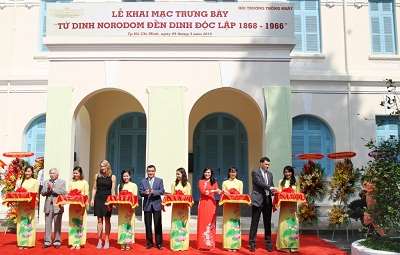
The exhibition “From Norodom Palace to Independence Palace (1868–1966)” not only presents historical documents but also offers a new interpretive framework. By placing events within their broader social, political, and cultural contexts, the exhibition helps visitors gain a deeper understanding of the people, the palace, and the historical transformations associated with this iconic site.
Source: Dan Tri
https://dantri.com.vn/van-hoa/trien-lam-tu-dinh-norodom-den-dinh-doc-lap-2018031221460981.htm