

Rarely Seen Images of the Life of Ngo Dinh Diem
Exhibition “From Norodom Palace to Independence Palace (1868–1966)”
Held in a two-story historic villa within the Reunification Hall complex.
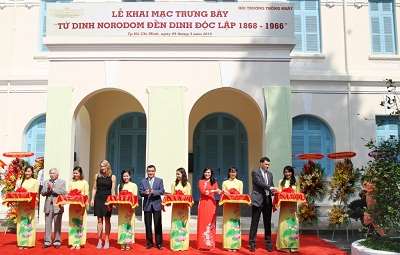
The exhibition opened on March 9 and is free to the public for two weeks, from March 10 to March 23.
On the ground floor, visitors are introduced to rare images of Norodom Palace – the residence and workplace of the Governor of Cochinchina, built by the French colonial administration in 1868. The narrow corridor space is effectively utilized to display photographs and documents related to the lives and careers of prominent southern intellectuals such as Truong Vinh Ky and Nguyen An Ninh.
A distinctive feature of the exhibition is its innovative approach to historical interpretation. Drawing on rich archival sources from national archives in Vietnam, the United States, and France, the exhibition offers a vivid, multi-perspective narrative of historical events and their contexts. Modern technologies are employed to convey historical stories, allowing visitors to watch, listen, interact, and explore history through personal experience.
Staircase walls and transitional spaces are used creatively to mark significant historical milestones, adding layers to the overall narrative of the exhibition.
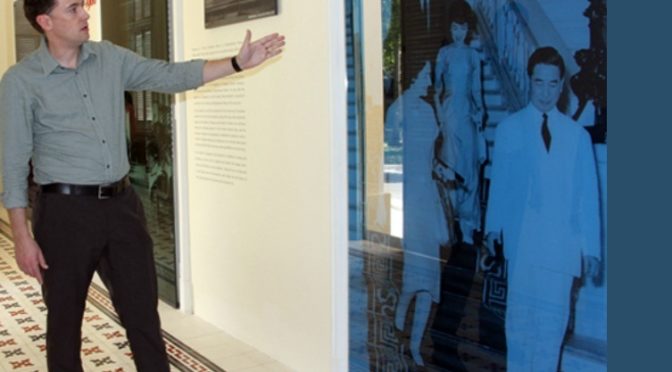
On the second floor, the exhibition space from the staircase to the room entrance presents the life trajectory of Ngo Dinh Diem – from his early career as a mandarin during the Nguyen Dynasty under Emperor Bao Dai to his rise as the first President of the Republic of Vietnam.
One room, themed “family-based rule,” features numerous images related to Ngo Dinh Diem’s life and the major political upheavals associated with the Independence Palace. Although he was the person who renamed Norodom Palace as Independence Palace and initiated its reconstruction, Ngo Dinh Diem never lived in the completed building.
Upon entering this room, visitors encounter a large family photograph of Ngo Dinh Diem displayed alongside the Ngo family genealogy. Archival materials and images of his relatives – including Ngo Dinh Kha, Ngo Dinh Nhu, Ngo Dinh Can, and Tran Le Xuan – are arranged chronologically to reflect historical developments.
Highlighted images include the Ngo Dinh family in Hue in 1961; Ngo Dinh Diem at the inauguration of the Mo Cay Agroville in Kien Hoa Province (Ben Tre) on July 15, 1960; and members of the Ngo family attending the Central Highlands Economic Fair in Buon Ma Thuot in February 1957.
Other significant photographs depict political and military events such as consultations at the Independence Palace in October 1954 to seek solutions for South Vietnam, Ngo Dinh Diem congratulating Colonel Duong Van Minh during the military parade in May 1955, and Ngo Dinh Diem with national army soldiers following the defeat of the Binh Xuyen forces in May 1955.
Several images document key alliances and power consolidations, including Ngo Dinh Diem receiving Nguyen Thanh Phuong and Trinh Minh The at the Independence Palace on March 31, 1955.
Personal artifacts are also displayed, such as a Canon Junior camera from around 1960, reflecting Ngo Dinh Diem’s strong interest in photography and camera collecting, particularly Canon models.
The exhibition further presents images of Ngo Dinh Diem at agroville sites such as Ba The (An Giang), as well as scenes of civilians observing military operations against the Binh Xuyen forces in May 1955.
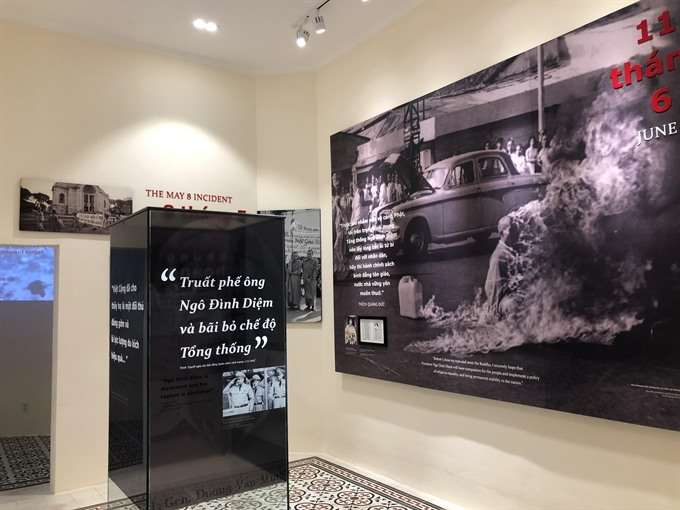
A major focal point of the exhibition is the photograph documenting the self-immolation of Venerable Thich Quang Duc on June 11, 1963, in Saigon, in protest against the Ngo Dinh Diem government’s repression of Buddhism. This event leads visitors through the narrative of the second coup against Ngo Dinh Diem and his subsequent assassination.
Additional images feature U.S. Ambassador Henry Cabot Lodge with Ngo Dinh Diem, the escape route of Ngo Dinh Diem and his brother Ngo Dinh Nhu, and architect Ngo Viet Thu presenting the architecture and interior design of the Independence Palace at its inauguration on October 31, 1966.
The exhibition concludes with images of visitors interacting with reconstructed spaces depicting the daily life of Saigon in earlier decades, emphasizing the exhibition’s experiential and educational approach.
Source: Phap Luat TP.HCM Online