

Intriguing “Inner-Court Secrets” of the Independence Palace
Sketch of the front façade of the Independence Palace
Photo: Special Archives of the Reunification Hall
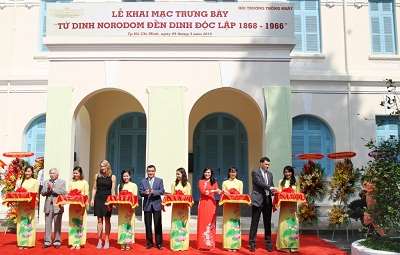
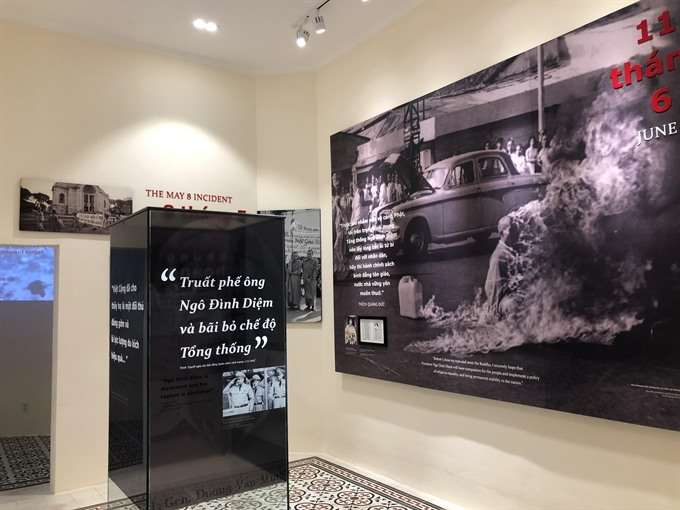
As previously reported by Thanh Nien, on the morning of March 9, the Reunification Hall – the managing authority of the Independence Palace, a Special National Historical Relic – officially inaugurated the exhibition “From Norodom Palace to Independence Palace (1868–1966)”, presenting more than 500 valuable historical documents and artifacts.
The exhibition is held in a two-story building constructed during the French colonial period, located within the Independence Palace complex. According to Ms. Ho Thi Thanh Minh, Deputy Head of the Interpretation Department (Reunification Hall), this building once served as the headquarters of the Democratic Party during the Second Republic of Vietnam. It existed prior to 1954 and was commonly referred to as the “White House.”
Several meeting records from the period of rebuilding the Independence Palace (circa 1964–1965) mention this building; however, its specific function within the overall palace complex has yet to be clearly identified.
The Independence Palace under construction
The Independence Palace in 1966
A letter written by sculptor Nguyen Van The to a family member, explaining the stone lattice screen surrounding the second floor
Why Was the Palace Built?
According to documents from the Reunification Hall, in order to assert French colonial authority in Cochinchina, the French administration decided to select an elevated site in the center of Saigon to construct a grand palace serving as the residence and workplace of the Governor of Cochinchina.
During the French conquest and pacification of Saigon in 1859, French naval admirals lived and worked aboard warships anchored on the Saigon River. It was not until February 25, 1861, after the capture of Chi Hoa Fortress, that Vice Admiral Charner left his flagship and established a temporary headquarters in the area known as Don Dat.
In December 1861, Rear Admiral Bonard ordered the construction of a temporary wooden residence at the end of Catinat Street (now Dong Khoi Street). The prefabricated structure was purchased from Singapore and is considered the first official residence of the Governor of Cochinchina in Saigon.
While seeking plans for a permanent governor’s palace, Rear Admirals Ohier and Roze encountered architect Achille Antoine Hermitte in Hong Kong. Upon returning to Vietnam, they proposed Hermitte as the designer of the new palace, a proposal later approved by Governor La Grandière.
The historic building within the Independence Palace grounds used as the exhibition venue
Photo: Quynh Tran
Visitors showing great interest in the extensive archival materials on display
Photo: Quynh Tran
On February 23, 1868, the groundbreaking ceremony for the Governor’s Palace was held with the participation of numerous high-ranking French officials. The project was carried out by the Saigon Department of Public Works, funded by the colonial budget at a cost exceeding 4.7 million francs—equivalent to one-quarter of the colonial budget at the time.
The palace was inaugurated on September 25, 1869, but interior decoration was not completed until 1875 due to political upheavals in France. Upon completion, the building was named Norodom Palace, after the boulevard it faced—Norodom Boulevard (now Le Duan Street).
Family Rule and Power Struggles under Diem–Nhu
According to records from the Reunification Hall, in June 1954 Bao Dai appointed Ngo Dinh Diem as Prime Minister of the State of Vietnam. On September 7, 1954, Diem officially received Norodom Palace from General Paul Ely, and the following day renamed it the Independence Palace.
The period from 1954 to 1956 is considered the most challenging phase of Ngo Dinh Diem’s administration, as it sought to consolidate power while confronting and suppressing opposition forces such as the Binh Xuyen, Hoa Hao, and Cao Dai sects through political maneuvering and military action.
A handgun associated with Madame Tran Le Xuan
Ngo Dinh Diem’s camera
Photo: Quynh Tran
Following the bombing attack on February 27, 1962, the Independence Palace suffered severe damage and could not be restored. President Ngo Dinh Diem decided to construct a new palace based on the design by architect Ngo Viet Thu, with the participation of sculptor Nguyen Van The and a team of engineers, architects, and skilled craftsmen.
Construction began on July 1, 1962, on the original site. The building covered an area of 4,500 square meters, rose to a height of 26 meters, and provided a total usable space of 20,000 square meters with more than 100 rooms. Each room was uniquely designed while remaining harmonious with the overall architectural composition.
A distinctive architectural highlight of the palace is the stone lattice screen encircling the second floor—an innovative idea proposed by sculptor Nguyen Van The, clearly documented through personal letters and archival materials displayed in the exhibition.
Upon completion, the Independence Palace was widely regarded as a landmark architectural achievement, harmoniously blending Eastern traditional elements with Western modernism, marking the conclusion of nearly a century of turbulent political and social history.
Le Cong Son
Source: Thanh Nien