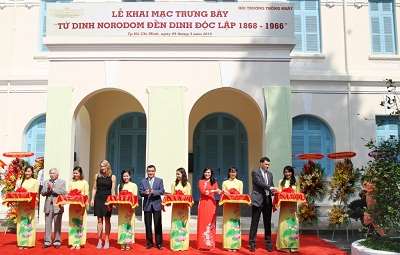


According to Ms. Tran Thi Ngoc Diep, Director of the Reunification Hall, the exhibition aims to clarify the historical narrative of Norodom Palace – a symbol of French colonial authority in Cochinchina – which was renamed Independence Palace in 1954 and has existed for nearly a century.
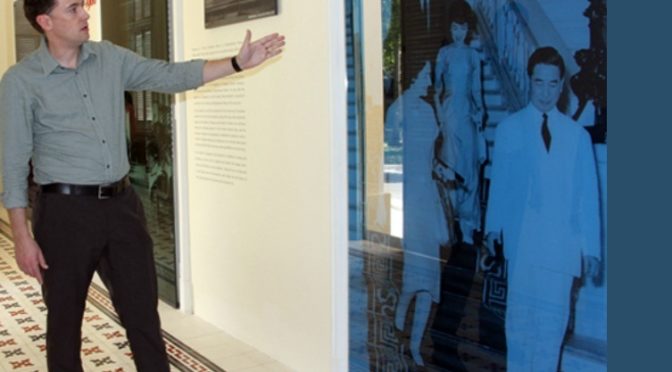
A room inside Norodom Palace, built in 1868. Photo: Manh Tung
The exhibition is held in a two-story building constructed during the French colonial period, located within the grounds of the Independence Palace.
The first floor introduces the origins of Norodom Palace through four thematic sections: the urban development of colonial Saigon, Norodom Palace, notable figures of Saigon, and a dynamic Saigon.
Images of old Saigon streets, the emergence of electric trams and early means of transportation, major boulevards, and urban life in the early 20th century are presented in short documentary films. Visitors can watch, listen, and interact with the content through modern technological devices.
The period from 1868 to 1966, during which Norodom Palace was built and existed, remains relatively unknown to the public due to limited surviving images and documentation.
“With abundant materials collected from national archives in Vietnam, the United States, and France, this exhibition offers a vivid and multi-dimensional interpretation of history, presenting events within their broader historical context,” Ms. Diep said, noting that the exhibition is the result of more than three years of collaboration among domestic and international experts.
Ms. Mary Tarnowka (left), U.S. Consul General in Ho Chi Minh City, visiting the exhibition. Photo: Manh Tung
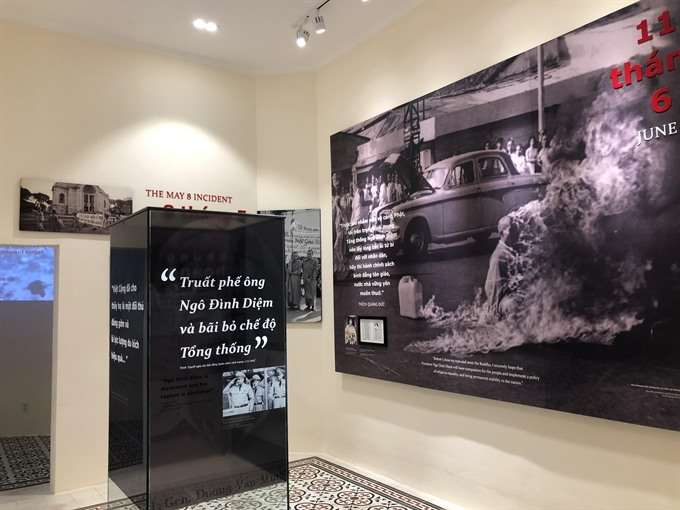
The second floor focuses on the formation and collapse of the Ngo Dinh Diem government, as well as the construction of the Independence Palace. Six themes explore the figure who renamed and rebuilt the palace, including: family-based rule, the struggle for power in Saigon, everyday life in Saigon, the 1962 bombing coup, the political crisis of 1963, and the construction of the new Independence Palace.
Among the highlights are many previously unused materials documenting the turbulent life of Ngo Dinh Diem, attracting considerable attention from visitors. These include photographs of Diem with soldiers after the defeat of the Binh Xuyen forces in May 1955; images of Nguyen Thanh Phuong and Trinh Minh The bringing their troops to cooperate with the government and being ceremonially welcomed; and records of Le Quang Vinh standing trial.
The exhibition is open to the public free of charge for two weeks, from March 10 to March 23.
A reconstructed space depicting old Saigon within the exhibition. Photo: Manh Tung
In 1868, the French colonial government designed and built a palace in the center of Saigon to serve as the residence of the Governor of Cochinchina. Upon completion, it was named Norodom Palace. From 1887 to 1945, successive French Governors-General used the palace as both their residence and workplace during the period of colonial rule in Indochina.
On March 9, 1945, Japan overthrew the French administration and took control of Indochina. Norodom Palace became the headquarters of the Japanese administration in Vietnam. Following Japan’s defeat in World War II later that year, the French returned to southern Vietnam, and the palace once again served as the center of French military operations.
In 1954, France withdrew from Vietnam after the Geneva Accords. On October 26, 1955, Prime Minister Ngo Dinh Diem deposed Chief of State Bao Dai, established the Republic of Vietnam, and assumed the presidency. The palace became the residence of the Ngo Dinh Diem family and a focal point of major political events.
On February 27, 1962, during a coup attempt, two pilots of the Saigon air force, Nguyen Van Cu and Pham Phu Quoc, flew AD-6 aircraft to bomb the palace, destroying the entire left wing of the main building. As restoration was impossible, Ngo Dinh Diem ordered the demolition of the old structure and the construction of a new palace on the same site, based on the design by architect Ngo Viet Thu.
While construction was underway, Ngo Dinh Diem was assassinated during a coup on November 2, 1963. President Nguyen Van Thieu of the Second Republic of Vietnam later presided over the inauguration ceremony and lived and worked at the palace from October 1967 until April 1975.
On April 30, 1975, tanks of the liberation forces entered the Independence Palace. The flag of the National Liberation Front of South Vietnam was raised atop the building, marking the reunification of the country.
The Independence Palace has since been recognized as a Special National Historical and Cultural Relic and is currently managed by the Reunification Hall, an agency under the Government Office.
Source: