

 |
|
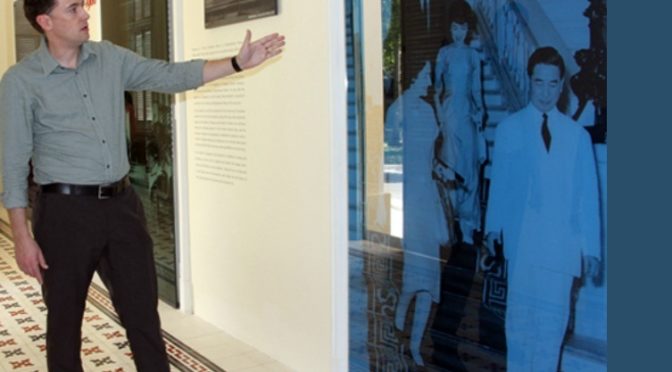
Madam Tran Le Xuan (wife of Ngo Dinh Nhu – advisor to President Ngo Dinh Diem) inspects Norodom Palace after it was bombed on February 27, 1962. Photo: LIFE. |
Recreating Old Saigon’s Atmosphere
The exhibition space is entirely located within the ancient villa in the Independence Palace complex, facing Nguyen Du street (District 1) – which once served as the working headquarters of the Democratic Party during the Second Republic of Vietnam.
On the ground floor, many valuable images of Norodom Palace – the residence and workplace of the Governor of Cochinchina built by the French administration starting in 1868 – are publicized. A large photograph of a room inside the Governor’s Palace is enlarged on the wall, giving viewers the feeling of standing in the space of more than a century ago.
Inside, four large screens project films compiled from images and documents, helping viewers visualize the process from the laying of the first stone for the construction of Norodom Palace, to the day it was bombed, collapsing the entire main section of the left wing.
The atmosphere and daily life of the people of Saigon from that period are also vividly recreated. Visitors can simultaneously view images, listen to commentary, and sense the bustling sounds of the streets and neighborhoods of old Saigon.
The rather small corridor on the ground floor is utilized to display photographs and documents about the lives and careers of prominent figures in Southern Vietnam, such as Truong Vinh Ky and Nguyen An Ninh.
The Man Who Named Independence Palace
On the second floor, the staircase and the door of the room are used to introduce the developments in the life of the President of the Republic of Vietnam, Ngo Dinh Diem, from the day he served as a Mandarin under the Nguyen Dynasty during the reign of King Bao Dai, to becoming the first president of the Republic of Vietnam.
Mr. Diem was the one who renamed Norodom Palace to Independence Palace and initiated the construction of the new palace, yet he never lived there for a single day.
 |
|
History Professor Edward Miller at the exhibition area. Photo: Manh Tung. |
Stepping into the room, viewers will see a photograph of Ngo Dinh Diem’s family spanning the entire wall, next to the genealogy of the Ngo Dinh lineage. Many photographs and documents about the lives of Ngo Dinh Diem’s relatives, such as Ngo Dinh Kha, Ngo Dinh Nhu, Ngo Dinh Can, and Madam Tran Le Xuan, are arranged according to the historical timeline.
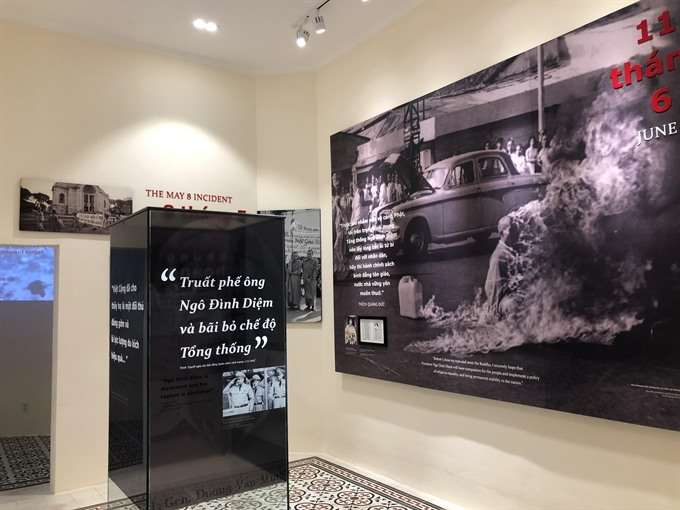
The self-immolation of Most Venerable Thich Quang Duc with gasoline on June 11, 1963, in Saigon to protest the Ngo Dinh Diem regime’s repression of Buddhism, along with a handwritten copy of his final testament before the self-immolation, is a focal point of this exhibition room. This leads viewers to the story of Ngo Dinh Diem’s second coup d’état and subsequent assassination.
History Professor Edward Miller – author of the book, ‘Misalliance: America, the Philippines, and the Fate of South Vietnam’ [The user text actually refers to “Liên minh sai lầm, Mỹ, Ngô Đình Diệm và số phận Nam Việt Nam,” which is commonly translated as ‘Misalliance: Ngo Dinh Diem, the United States, and the Fate of South Vietnam’] – contributed many valuable photographs and documents to the Ngo Dinh Diem family display. His sources were gathered from various archives in Vietnam, the United States, and France.
“We want to offer historical interpretation to the viewers, not just simply recreate the events. Because you must understand history within a specific context, not as isolated moments in time,” Professor Edward Miller stated.
The events following the overthrow of Ngo Dinh Diem, when he had to flee and seek refuge with his brother Ngo Dinh Nhu, are visually presented by Edward Miller and his colleagues using a map of Saigon at that time, along with specific timelines.
“I particularly like the images and their stories. Each image carries a different message. We hope that viewers will learn and understand history in the most accessible way after touring the exhibition,” Edward Miller shared.
Following the project closely since 2012, Dr. Le Thi Minh Ly (Vietnam Cultural Heritage Association) and the working group from the Reunification Hall traveled to the United States to collect documents for three weeks at various archives and museums. The trip brought back many extremely valuable materials, which will present images previously unknown to many Vietnamese people.
“Aside from the content and images, we paid great attention to the aesthetics. The color coordination, the arrangement of images, the density of the displays, the typography… were all carefully prepared to bring about a sense of comfort and the best possible reception for the viewers,” Dr. Le Thi Minh Ly remarked.
 |
|
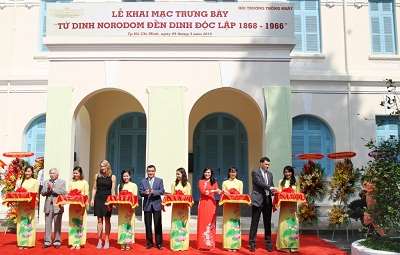
The ancient villa within the Independence Palace complex, where the exhibition ‘From Norodom Palace to Independence Palace 1868-1966’ will take place. Photo: Manh Tung. |
The exhibition ‘From Norodom Palace to Independence Palace 1868-1966’ offers free admission during the first two weeks. Following this, the Reunification Hall will maintain the exhibition for at least three years, ensuring that more people have the opportunity to access these rare historical materials.
|
In 1868, the French administration commissioned the design and construction of a palace in the heart of Saigon to serve as the residence for the Governor of Cochinchina. When completed, it was named Norodom Palace. From 1887 to 1945, several generations of French Governors-General used this palace as their residence and workplace throughout the period of the invasion of Indochina. On March 9, 1945, the Japanese staged a coup against the French, occupying Indochina exclusively. Norodom Palace then served as the workplace for the Japanese administration in Vietnam. In September of that year, Japan was defeated in the Second World War, and the French returned to occupy Southern Vietnam (Nam Bộ); the palace became the headquarters for the French war machine. In 1954, France withdrew from Vietnam following the Geneva Accords. On October 26, 1955, Prime Minister Ngo Dinh Diem deposed Head of State Bao Dai, established the Republic of Vietnam, and became its President. The palace became the residence of Ngo Dinh Diem’s family and witnessed many political upheavals. On February 27, 1962, the coup faction sent two pilots from the Saigon army, Nguyen Van Cu and Pham Phu Quoc, to fly two AD6 aircraft and bomb the palace, causing the entire main section of the left wing to collapse. As it could not be restored, Ngo Dinh Diem ordered the palace to be leveled and a new palace built on the old foundation, following the design of Architect Ngo Viet Thu. While the new structure was under construction, Ngo Dinh Diem was assassinated by the coup faction on November 2, 1963. Nguyen Van Thieu, the President of the Second Republic of Vietnam, presided over the inauguration ceremony and lived in the palace from October 1967 until April 1975. On April 30, 1975, liberation army tanks advanced into Independence Palace. The flag of the National Liberation Front of South Vietnam was raised on the roof of the palace, marking the day of national reunification. Independence Palace is recognized as a National Historical and Cultural Site and is currently managed by the Reunification Hall (an agency under the Government Office). |