


History of the Independence Palace
The Independence Palace is one of the most significant historical and architectural landmarks of Ho Chi Minh City, closely associated with the struggle for national independence and reunification of the Vietnamese people. Over more than 150 years of formation and transformation, the site has witnessed colonial rule, major political upheavals in Southern Vietnam during the 20th century, and especially the historic moment of April 30, 1975 — a milestone marking the end of the war and the beginning of an era of peace and national reunification.
After completing the occupation of Cochinchina in 1867, the French colonial authorities began constructing administrative buildings to serve the colonial government. On February 23, 1868, the Governor of Cochinchina, La Grandière, laid the first stone for the construction of Norodom Palace on a site of approximately 12 hectares, intended as the residence and workplace of the Governor. The palace was completed in 1871.

From 1887 to 1945, Norodom Palace served as the headquarters of successive Governors-General of French Indochina. On March 9, 1945, Japanese forces staged a coup against the French administration and took control of the palace. After Japan’s surrender in September 1945, the French reoccupied Southern Vietnam and continued to use the palace as the center of colonial administration until 1954.

After the defeat at Điện Biên Phủ, France signed the Geneva Accords and withdrew from Vietnam. On September 7, 1954, General Paul Ely, representing the French government, formally transferred Norodom Palace to the State of Vietnam, received by Prime Minister Ngô Đình Diệm. On September 8, 1954, the palace was renamed Independence Palace and became the Presidential Palace of the First Republic of Vietnam.


On February 27, 1962, Independence Palace was severely damaged during a bombing carried out by pilots Nguyễn Văn Cử and Phạm Phú Quốc. President Ngô Đình Diệm decided to demolish the old structure and construct a new palace on the same site, based on the design by architect Ngô Viết Thụ — the first Vietnamese architect to win the Prix de Rome. Construction began on July 1, 1962.


While the new palace was still under construction, Ngô Đình Diệm was overthrown and killed in the coup of November 2, 1963. The new Independence Palace was officially inaugurated on October 31, 1966, under the chairmanship of Nguyễn Văn Thiệu, Chairman of the National Leadership Committee. From 1967 to 1975, President Nguyễn Văn Thiệu was the leader who lived and worked at the palace for the longest period.

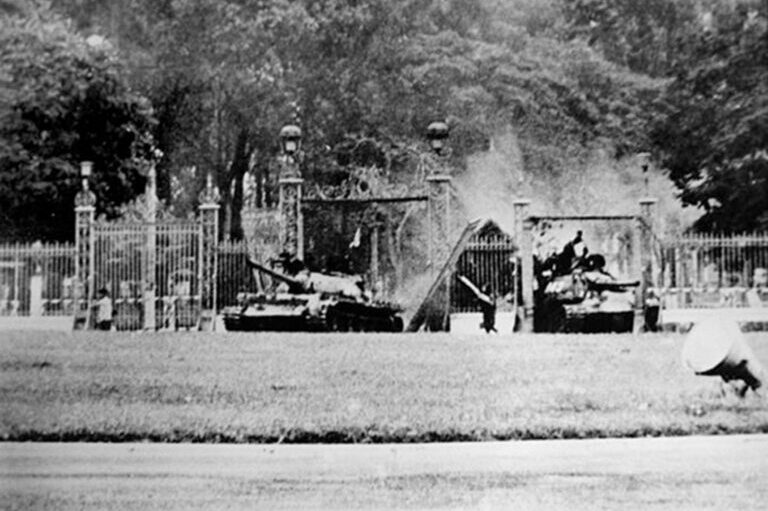
At 10:45 a.m. on April 30, 1975, tank number 843 of Brigade 203 rammed through the side gate of the Independence Palace. Shortly afterward, tank number 390 broke through the main gate and advanced into the palace grounds. At 11:30 a.m., Senior Lieutenant Bùi Quang Thận, commander of tank 843, raised the flag of the National Liberation Front of South Vietnam atop the palace, marking the complete collapse of the Republic of Vietnam government. The last President, Dương Văn Minh, declared unconditional surrender. This historic event officially ended 30 years of war and opened a new era of national reunification under the leadership of the Communist Party of Vietnam.
Given its exceptionally important historical significance, on June 25, 1976, the Minister of Culture signed Decision No. 77A/VHQĐ granting special recognition to the Independence Palace as a National Historical and Cultural Relic. On August 12, 2009, the Prime Minister issued Decision No. 1272/QĐ-TTg classifying the Independence Palace as a Special National Monument — one of the first ten sites nationwide to receive this distinguished status.

Today, the Independence Palace is a key destination for exploring modern Vietnamese history and attracts large numbers of domestic and international visitors. In addition to serving as a heritage attraction, the Palace is also a venue for major events and official receptions for delegations hosted by the Party, the State, and Ho Chi Minh City.

Alongside conservation efforts, the Independence Palace is gradually implementing exhibition programs, digitalization initiatives, and the application of new technologies to present its heritage values in a vivid and modern manner, enhancing visitor experience and expanding public accessibility.